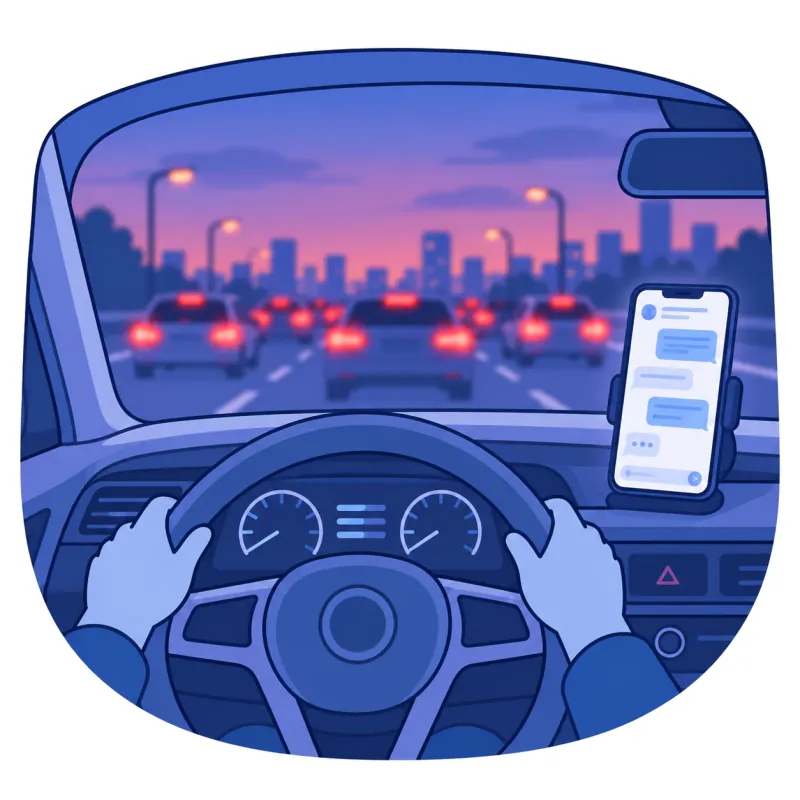
In car and truck crashes where distraction, visibility, or reaction time is disputed, the questions are what the driver could see, where their eyes were, and how long a glance away from the road lasted. Dr. Sawyer answers them from his own peer-reviewed driving research, including research done at MIT’s AgeLab in the Center for Transportation and Logistics, where he was a postdoctoral associate and then a research scientist.
The cases include phone use and in-vehicle screens at the wheel, trucking crashes, and drivers who looked toward a brake light, a pedestrian, or a stopped vehicle and still did not respond in time. Driver assistance systems add a question about trust: what the driver understood the system to be doing, and where that belief sent their eyes. Ignition interlocks add one more, because the device asks for breath retests while the engine is running, usually on the move.
His published research covers how drivers take in visual information from the road, how distraction affects the detection of brake lights, how voice interfaces affect mirror checks in older and younger drivers, and the link between trust in vehicle technology and where drivers look in on-road driving. His Human Factors study of texting on a head-mounted display and on a smartphone won the International Ergonomics Association’s K.U. Smith Award. He is first author of a Human Factors and Ergonomics Society paper evaluating drivers who take ignition interlock breath tests while driving, and of the Handbook of Human Factors and Ergonomics chapter on automation, autonomy, and artificial intelligence. The methods are on-road studies, driving simulation, and eye tracking, applied to the timing, sightlines, and vehicle data of the crash at issue.
Selected publications
- Wolfe, B., Sawyer, B. D., & Rosenholtz, R. (2022). Toward a theory of visual information acquisition in driving. Human Factors, 64(4), 694–713.
- Wolfe, B., Sawyer, B. D., Kosovicheva, A., Reimer, B., & Rosenholtz, R. (2019). Detection of brake lights while distracted: Separating peripheral vision from cognitive load. Attention, Perception, & Psychophysics.
- Geitner, C., Sawyer, B. D., Birrell, S., Jennings, P., Skrypchuk, L., Mehler, B., & Reimer, B. (2017). A link between trust in technology and glance allocation in on-road driving. Proceedings of the Ninth International Driving Symposium on Human Factors in Driver Assessment, Training and Vehicle Design.
- Sawyer, B. D., Lee, J., Dobres, J., Mehler, B., Coughlin, J. F., & Reimer, B. (2016). Effects of a voice interface on mirror check decrements in older and younger multitasking drivers. Proceedings of the Human Factors and Ergonomics Society Annual Meeting, 60(1), 95–100.
- Sawyer, B. D., & Hancock, P. A. (2014). An evaluation of drivers using an ignition interlock device: Breath tests while driving. Proceedings of the Human Factors and Ergonomics Society Annual Meeting, 58(1), 2098–2101.